


A century in the canopy

The value Mahi Rākau has added to the Kaingaroa Forest Estate over the past 30 years can not be overstated. If we were to consider the current rotation, their crews have planted about 90% of the crop, and there are more than 150 million trees in a rotation. Directors Ray Waiariki and Stewart Hyde reflect on their forestry careers and how the industry has changed.
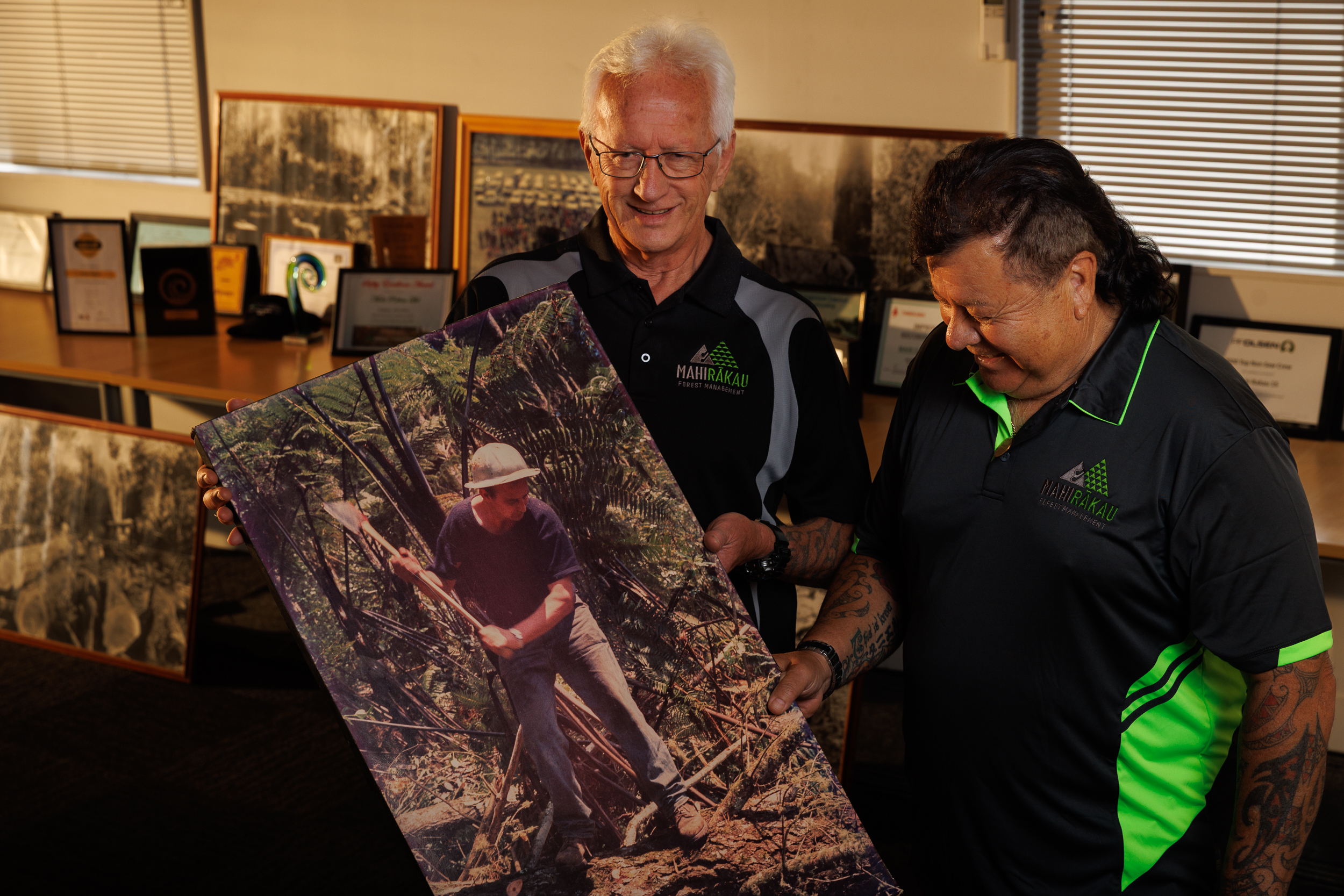
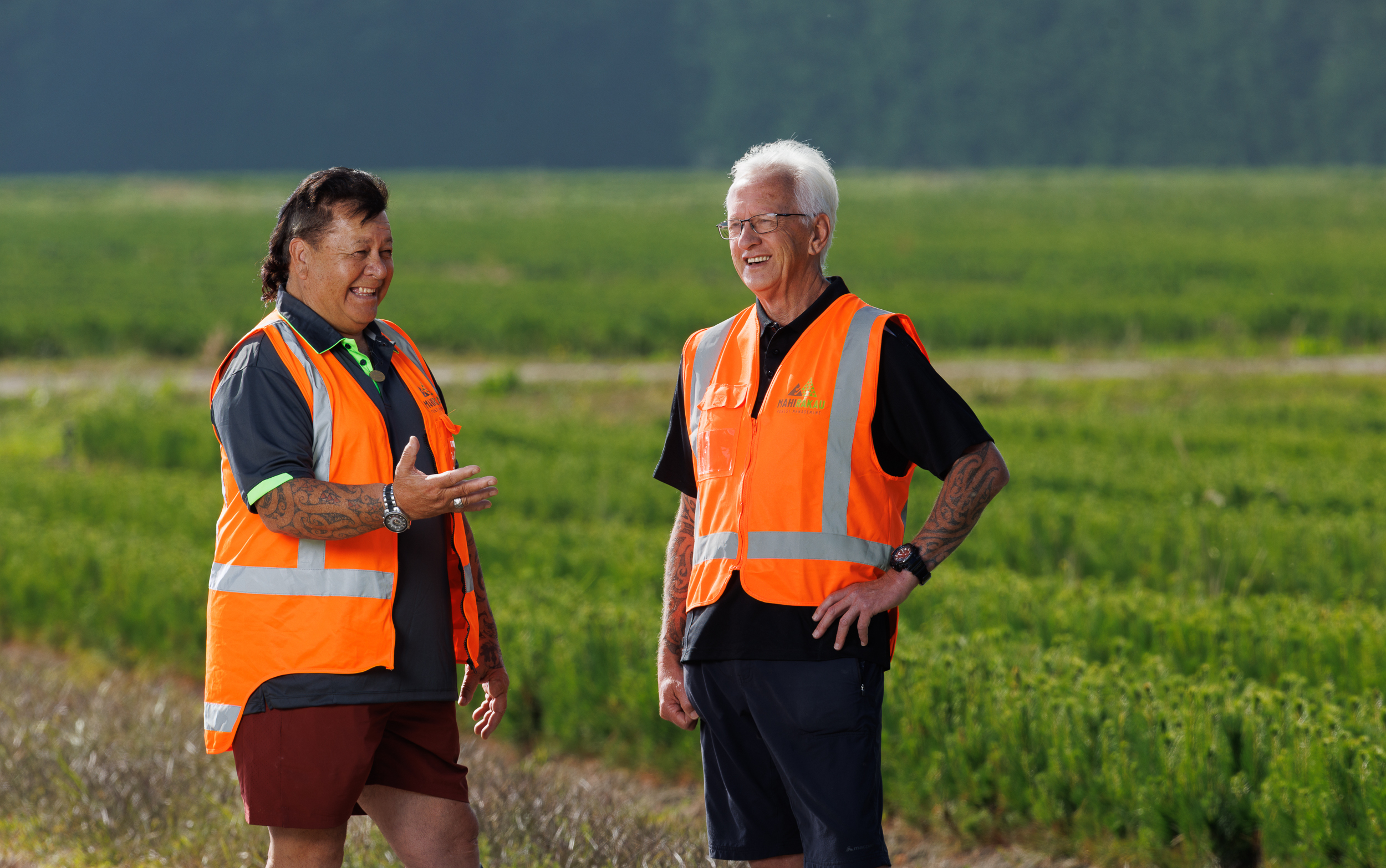
Few can claim a lifetime in the forests of Aotearoa quite like Ray Waiariki (Ngāi Tūhoe) and Stewart Hyde (Ngāti Raukawa, Ngāti Maniapoto). Between them, these two forestry stalwarts have spent more than a century working in the industry — witnessing its transformation from a rugged, hands-on trade to an increasingly mechanised and regulated profession.
As directors of Mahi Rākau, formerly known as CNI Forest Management, their impact on the forestry sector in the Central North Island has been profound, shaping both the workforce and industry practices.
Ray Waiariki’s connection to forestry is lifelong. Born and raised in Kaingaroa, the forest has provided employment and served as his "playground and bread basket". By the time he was a teenager in the 1960s, Ray was already working in the industry, cutting his teeth in logging and extraction with Kaingaroa Logging Company.
“At 15, I started a formal apprenticeship at KLC. We were given an axe, a helmet, a pair of boots, a swannie and away we went," he says.
He started trimming trees with an axe before going through every department — working in the wire rope shop and the service and chainsaw departments. He says it was a tough three-year apprenticeship, but it laid the foundation for everything that came after.
“The work ethic was strong. Everyone learned the ropes from experienced foresters who expected nothing less than 100% effort. There were no lightweight tools or fancy gear — just grit and hard work."
Ray remembers that his starting pay as an apprentice was just 38 cents an hour, which increased to around 50 cents by the time he finished. "Petrol and food were cheap back then, so I thought that was good money."
Stewart Hyde’s journey began in 1969 as a forest labourer in Manawatu before he joined the Woodsman Training School based at Golden Downs Forest, south of Nelson. Stewart recalls his starting salary was $800 a year. "I got about $30 a fortnight in cash in a brown envelope and then had to pay our hostel cook about $10.
"Jobs back then were pretty much the same as today, except the tools were different. High pruning was done with a polesaw, planting with a mattock and planting bag, and thin to waste was done with an axe. No chainsaws for us Woody's.
"Our work vehicles were a Bedford gang bus and no radios in them. We had to set up an ex-army field radio and run an aerial between two trees."
By 1976, he had launched his own contracting career, working in Tairua before returning to the Central North Island in 1980. His company steadily grew from a small two-man operation to a major contractor employing more than 70 people.
Transformations in the industry
The forestry industry has evolved since Ray and Stewart first picked up their tools. In the 1980s, the corporatisation of the New Zealand Forest Service marked a significant turning point. The restructuring led to the rise of private contractors as forest owners moved away from employing wage crews.
“That was a big shift,” Stewart explains. “We went from small operations to running a big workforce. The demand for skilled forestry workers skyrocketed, and contractors had to step up to fill the gap left by the government.”
Health and safety has been another major transformation. In the past, forestry was a high-risk industry with minimal oversight. Today, rigorous safety regulations, drug testing programs, and advanced training have improved conditions.
“Back in the day, if you tested forestry workers for drugs and alcohol, a lot of them would’ve failed,” Ray admits. “Now, we’ve got a culture shift — safety is front and center, and workers are held to a higher standard.”
Stewart agrees. “There’s more record keeping and you definitely have to dot your ‘i’ and cross your ‘T’s’, but it’s a shared responsibility. I believe the quality of work is better today as a result, especially during the planting season. There’s a real focus on getting it right.”
The birth of Mahi Rākau
In 1998, Ray, Stewart, and a group of contractors formed a collective that became a key supplier of silviculture work to Fletcher Challenge Forest over the North Island. This partnership allowed them to secure the majority of work available, growing their influence and refining their business model. They started with a team of 350 workers.
“The early years were tough,”
“We had to take on responsibilities that were once handled by big forestry companies — planning, supervision, compliance. But we thrived because we took a proactive approach, adapting to changes before they hit us.”
In recent years, the company rebranded as Mahi Rākau, embracing a name that reflects its Māori heritage and commitment to the whenua. “We are a proud Māori-owned company with deep roots in forestry,” says Stewart. “The rebrand was about aligning our identity with our values and the people we represent.” They now employ about 160 people.
Challenges and change
Recruitment remains one of the biggest challenges facing forestry today. Despite offering competitive wages and stable employment, attracting young workers, including local talent, has become difficult.
“Getting young people into the industry is tough, the work is physically demanding, remote, and what appealed to us as young foresters doesn't have the same appeal to the young people of today. It's a hard sell to a generation raised on technology.”
To address this, Mahi Rākau has welcomed more immigrant workers. They also launched a wahine crew in 2019, providing a safe and supportive entry point for women in forestry.
A decision to phase out pruning in Kaingaroa Forest for five years was also a challenging period for the business. At the time, pruning was a major part of their silvicultural services, providing year-round employment for crews outside of planting.
“When pruning started phasing out, we had to pivot fast,” Ray says.
“We set up new contracts, expanded into different areas, and made sure our workforce had opportunities elsewhere. You can’t afford to stand still in this business.”
The pair have seen forest owners come and go over the years. Where there was once a Master-Servant relationship with contractors, Stewart says those attitudes have changed. “We have closer working relationships with owners now.”
A legacy of leadership
Looking ahead, Ray and Stewart see a future where collaboration between contractors and forest owners strengthens further, ensuring a sustainable industry for future generations. They also anticipate more technological advancements, though they remain skeptical about full mechanisation.
“No matter how much technology improves, you’ll always need boots on the ground,” Stewart says. “Some jobs just can’t be done by machines.”
Ray takes immense pride in what Mahi Rākau has achieved, particularly in the recognition they have received. “Winning awards and being seen as industry leaders means a lot,” he says. “We’ve always strived to be the best at what we do. When I hear Mahi Rākau called out at an event or see our people being acknowledged, I feel proud. Not just of what Stewart and I have built, but of the hardworking teams that got us here.”
From the days of axes and ropes to the modern, highly regulated industry of today, Ray and Stewart have been at the forefront of forestry’s evolution. Their legacy isn’t just in the trees they’ve managed, but in the countless workers they’ve mentored, the innovations they’ve championed, and the resilience they’ve instilled in the industry.
Mahi Rākau stands as a testament to their vision — a company rooted in history, yet always looking forward.